Showing posts with label Narra. Show all posts

Friday, June 3, 2011

Inamorata Casegoods - The Story Behind Their Creation


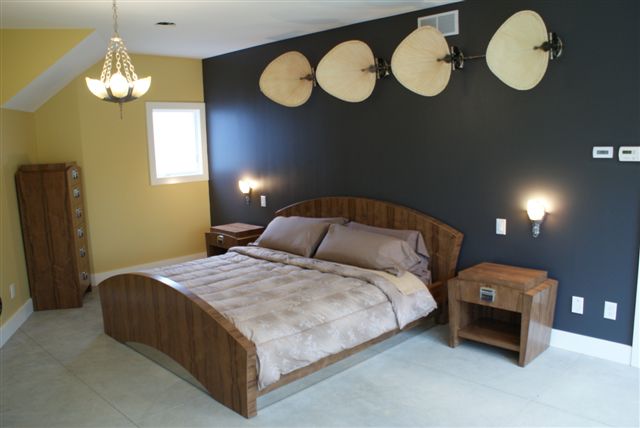
A few years ago we received a special commission to make a custom Irenic Bed out of East Indian Laurel. In addition to the bed the clients were keen on having some complementary casegoods made - namely a pair of dressers and a pair of night stands.

Inspired by the sweeping arc of the bed design we conceptualized a casegood profile that would emulate the silhouette of the Diego Humidor.

The resulting casegoods are shown below. To counterbalance the warmth of the wood we introduced the coolness of steel through the use of large polished steel pulls. Given the vibrant presence of the wood grain it was necessary to make the size of the custom pulls substantial, with the grips and detailing crafted out of black rubber.


The back of the main dresser was fully finished, which is a standard feature incorporated into all of our custom furniture designs.


The tall chest shown below was initially conceived of as a shorter dresser until a problem was discovered with how the builder proportioned the master bedroom. This unexpected glitch was quickly resolved with the suggestion that we transform the dresser into a vertical chest of drawers, thereby allowing it to fit a niche in the room.


Once again the back is fully finished.


Each of the night stands has a single drawer, with storage below for books.


In tandem with this we crafted another version of the Irenic Bed as shown below - this time out of natural Cherry. Because of the subtleness of the Cherry grain we decided to cut the wood at slight angles to create a radiating pattern to symbolize a rising Sun.


For this commission the client requested large center drawers on the dresser, and smaller cubbie drawers on each side. Since the wood grain of the Cherry was not as pronounced as the East Indian Laurel, a more subdued satin nickel pull was selected.


This 7 drawer cabinet is called a semainaire, which is derived from a French word used to describe a lady's lingerie chest having one drawer for each day of the week.


One key feature of this custom piece is the discrete locking compartment that was integrated into the underside of the top. The compartment was lined in black Tuscany leather. Both the lock and hinges were plated in 18K gold.


The night stands each feature 3 large drawers...


and a fully finished back.


This corner detail shows the cascading grain pattern on the pilasters.


Inlaid into the back of each of the cabinets was a small convex inlay of a wood known as Narra. This particular selection of Narra carries a special provenance in the world of sustainable forest management because it comes from the last remaining board known to exist of the very first wood to be sustainably harvested on the Solomon Islands in the early to mid-1990s. This Narra made its way into North American by way of Eco-Timber in California.


All drawers are dovetailed solid maple, running on concealed linear ball bearing self-closing glides.


For management of various electronic devices some custom charging stations were built into each of the night stands, so that cell phones, Bluetooths, Blackberrys and digital cameras could be simultaneously stored and charged.

The power bar and excess wiring were concealed under a removeable tray that was inlaid with slots and pockets for storage.


This resulting casegoods collection is called Inamorata.

Inamorata comes from the Latin words "in" and "amore", with the loose translation being "to inspire with love".


Sustainable, Environmental, Eco Lifestyles, Healthy, All Natural, Home and Garden, Interior Design, Eco Friendly, Green Furniture, Green Furnishings, Green Designs, FSC Certified, Reclaimed Materials. Organic, LEED compliant, NAUF. CARB2, Bamboo, Natural Fibers. Non-Toxic, low-VOC, Non VOC, Natural Finishes.

Friday, February 11, 2011

"Da Hah' da nyah" Keepsake Box

The design of this "Da Hah' da nyah" keepsake box is actually a variation of the original Tekendoos design I first created in the mid-1990s.


Measuring 10" long x 5" deep x 2-3/4" high this box has been crafted from FSC certified wood, with the exterior being clad in a wood called Narra. This Narra carries a special provenance in the world of sustainable forest management in that it comes from the last remaining board known to exist of the very first wood to be sustainably harvested on the Solomon Islands in the early to mid 1990s. The interior is felt lined.

The inlay on the top of the box was inspired by an aboriginal glyph of a turtle. This image is symbolic for many reasons, since turtles are one of the oldest forms of life and the shell is symbolic of protection. Because of its great age and slow metabolism the turtle is also associated with longevity.

The wood that was used to make the inlay comes from a tree that is a member of the Black Walnut (Juglans nigra) family of trees. Native American medicine women discovered through many generations of trial, error and observation that this wood has holistic medicinal properties that are conducive to healing. In recent years a scientific basis to support this ancient wisdom has been discovered and these molecules (known scientifically as ellagitannins) are now at the leading edge of research into finding a cure for cancer.


The name Da Hah' da nyah comes from the Seneca Iroquois, and means "he protects the forest". This is appropriate considering that the specific design of this particular box was originally commissioned as a gift for the Forest Stewardship Council (FSC) in 2004.

Monday, September 13, 2010

Ellipse II Table - The Story Behind its Creation

In 2002 I began to experiment with ideas on how to bend wood across complex three dimensional planes. In the course of doing this I inadvertently created a tapered elliptical cone shape that, at first glance, looked ideal for a dining table base.

After building a prototype of the cone my next challenge was making the top. After heeding advice to "keep it simple" I settled on a pure elliptical oval shape with bookmatched grain and flat edge apron. A 1" high stainless steel plinth was added to the underside of the base. The resulting table was finished in Tobacco Mahogany, and named the Ellipse Dining Table.


Although the resulting table looked OK, there was something about it that was just plain missing. What bothered me most was the finish - which was a basic chocolate/mocha/expresso brown. At the time this was a safe finish to use, because just about every professional in the interior design industry was using it in one form or another since it "went with everything".

One could probably credit Holly Hunt and Christian Liaigre with first introducing this look to the high end of the market in the 1990s. By the early 2000s, however, the finish was everywhere and I soon realized that to be the main problem. Namely, because of the finish this table was looking like everything else out there - even the cheap dross knock-offs that were now beginning to flood the market by the containerload from offshore.

By 2006 I decided to refine the design with some subtle changes. I began by using a wood called Nero Chaquiro, which is a lesser known species that comes from an FSC certified forest in Brazil. In addition to being certified as sustainably harvested the use of this wood also helps support an indigenous community living along the banks of the Amazon River by providing a tangible incentive for the peoples living there to manage their surrounding forest responsibly.

The main structure of the table was crafted out of FSC certified ply, which was also NAUF and CARB2 compliant due to the fact that there were no added urea formaldehydes in the glues and binders. To minimize the heaviness of the top the grain pattern was changed to sunburst and the edge profile became a deep undercut bevel. The stainless steel plinth was removed in lieu of a small convex inlay of Narra being added as a subtle detail. The resulting table was finished in a low-VOC water based urethane, and renamed the Ellipse II Table.


Taken together these changes created a more sculptural look to the design, and the response from the design community was tremendously positive. Our ability to custom tailor this design to meet the requirements of each individual client has since resulted in the Ellipse II Table becoming one of our most popular offerings today.

In October 2008 a custom commission of this table for interior designer Wendy Blount was even published in an issue of Metropolitan Home magazine.


Thanks to the positive response this article received, the table photo was subsequently republished in the book "Glamour: Making it Modern" by Michael Lassell.


Sustainable, Environmental, Eco Lifestyles, Healthy, All Natural, Home and Garden, Interior Design, Eco Friendly, Green Furniture, Green Furnishings, Green Designs, FSC Certified, Reclaimed Materials. Organic, LEED compliant, NAUF. CARB2, Bamboo, Natural Fibers. Non-Toxic, low-VOC, Non VOC, Natural Finishes.

Tuesday, August 31, 2010

500 Tables

In "500 Tables" by Lark Books esteemed juror Andrew Glasgow selected a wide array of table styles and forms, from pieces that showcase masterful artwork to ones that feature alternative materials and aesthetic sensibilities. Published in 2009 this book features more than 300 artists.

We had the good fortune of having three tables selected for this publication.


This Cuff Link Table measures 12" dia and 18-1/2" high and is made of a wood called Madero Acero. The wood on the top was cut into a sunburst pattern, with the grain allowed to cascade as a waterfall down the tapered cone sides. A polished stainless steel collar separates the split cone segments.


"Solomon's Desk" measures 50-7/8" long by 18-7/8" wide by 29" high. It was crafted from a rare sampling of Narra timber that came from of the very first batch of wood to be sustainably harvested on the Solomon Islands in the early to mid-1990s. This Narra made its way into North American by way of Eco-Timber in California.


A pencil drawer with bevelled edge was discretely inset into the edge of the top.

Inside the drawer is a lidded tray made of Hawthorn and Sassafras woods. Both of these woods were used in traditional medicine for their aromatherapeutic and Ayurvedic properties. These scents accumulate naturally inside the drawer while it is closed, before being released when it is opened.


The drawer box is literally a puzzle that is fitted together by means of sliding dovetail construction. The back mitres are joined by a solid walnut dovetailed key, while the Narra bottom is set into dadoes on all 4 sides.


The finger pull inlay on the underside of the top is crafted from a special sampling of Black Walnut (Juglans nigra). It is relevant that this is located in a place that is frequently touched because Native American medicine women discovered through many generations of trial, error and observation that this wood has medicinal properties said to be conducive to healing. It was believed that simply touching this wood would release the active molecules to the surface of one's skin, where they could be naturally absorbed into the pores.

Although such claims were initially dismissed as little more than old wives' tales, these active molecules (known scientifically as ellagitannins) are currently at the leading edge of research into finding a cure for cancer.


The Whale Tail Desk was crafted from a reclaimed flitch of Macassar Ebony veneer, with the high gloss finish helping create the illusion of a Right Whale breeching in preparation for a deep dive.


An anthracite grommet in the top allows wiring to access the floor by means of a vertebrae wire management system hidden inside the lower torso of the desk. Stability is achieved by securing the desk to the floor by means of hidden fasteners.

Monday, August 30, 2010

Diego and Inamorata Casegoods


A few years ago we received a special commission to make a custom Irenic Bed out of East Indian Laurel. In addition to the bed the clients were keen on having complementary casegoods made - namely a pair of dressers and a pair of night stands.

Inspired by the sweeping arc of the bed design we conceptualized a casegood profile that would emulate the door sweep of the Diego Humidor.

The resulting casegoods are shown below. To counterbalance the warmth of the wood we introduced the coolness of steel through the use of large polished steel pulls. Given the vibrant presence of the wood grain it was necessary to make the size of the custom pulls substantial, with the grips and detailing crafted out of black rubber.


The back of the main dresser was fully finished, which is a standard feature incorporated into all of our custom furniture designs.


The tall chest shown below was initially conceived of as a shorter dresser until a problem was discovered with how the builder proportioned the master bedroom. This unexpected glitch was quickly resolved with the suggestion that we transform the dresser into a vertical chest of drawers, thereby allowing it to fit a niche in the room.


Once again the back is fully finished.


Each of the night stands has a single drawer, with storage below for books.


In tandem with this we crafted another version of the Irenic Bed as shown below - this time out of natural Cherry. Because of the subtlety of the Cherry grain it was decided to cut the wood at slight angles to create a radiating pattern to symbolize a rising Sun.


For this commission the client requested large center drawers on the dresser, and smaller cubbie drawers on each side. Since the wood grain of the Cherry was not as intense as the East Indian Laurel, a more subdued satin nickel pull was selected.


This 7 drawer cabinet is called a semainaire, which is derived from a French word used to describe a lady's lingerie chest having one drawer for each day of the week.


One key feature of this custom piece is the discrete locking compartment that was integrated into the underside of the top. The compartment was lined in black Tuscany leather. Both the lock and hinges were plated in 18K gold.


The night stands each feature 3 large drawers...


and a fully finished back.


This corner detail shows the cascading grain pattern on the pilasters.


Inlaid into the back of each of the cabinets was a small convex inlay of a wood known as Narra. This particular selection of Narra carries a special provenance in the world of sustainable forest management because it comes from the last remaining board known to exist of the very first wood to be sustainably harvested on the Solomon Islands in the early to mid-1990s. This Narra made its way into North American by way of Eco-Timber in California.


All drawers are dovetailed solid maple, running on concealed linear ball bearing self-closing glides.


For management of various electronic devices some custom charging stations were built into each of the night stands, so that cell phones, Bluetooths, Blackberrys and digital cameras could be simultaneously stored and charged.

The power bar and excess wiring were concealed under a removeable tray that was inlaid with slots and pockets for storage.


This resulting casegoods collection is called Inamorata.

Inamorata comes from the Latin words "in" and "amore", with the loose translation being "to inspire with love".


Sustainable, Environmental, Eco Lifestyles, Healthy, All Natural, Home and Garden, Interior Design, Eco Friendly, Green Furniture, Green Furnishings, Green Designs, FSC Certified, Reclaimed Materials. Organic, LEED compliant, NAUF. CARB2, Bamboo, Natural Fibers. Non-Toxic, low-VOC, Non VOC, Natural Finishes.